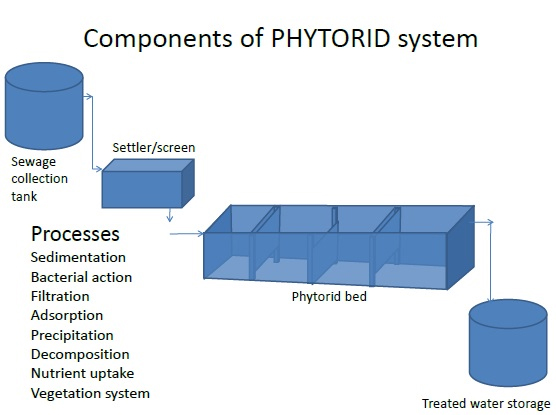
With the design and technical advice of Mr. Rajesh Biniwale, Principal Scientist of the National Environmental Engineering Research Institute (NEERI), the Sangam has constructed an effluent treatment plant at Mamta cottage hospital, Bamhani. This help and co-operation has come about following visits by a number of the volunteers on the international "weltwäerts" programme who were working with the Sangam’s Agricultural team on Organic Farming and Watershed development on the model farm at Bamhani. Similar assistance is also being extended by NEERI to the staff of Mure Memorial Hospital and a number of participant partners in the volunteer placement scheme.
The Phytorid Bed Technology may be constructed in series and parallel modules/cells depending on the land availability and quantity of wastewater to be treated. It is a subsurface flow type in which wastewater is applied to cell/system filled with porous media such as crushed bricks, gravel and stones. The hydraulics are maintained in such a manner that wastewater does not rise to the surface retaining a free board at the top of the filled media. This system consists of three zones (i) inlet zone composed of crushed bricks and different sizes of stones (ii) Treatment zone consist of same media as in inlet zone with plant species and (iii) an Outlet zone or treated water storage area.
The system is based on the bio-filter plants (plants that can take their nutrient directly from the water) including Elephant grass (Pennisetum purpurem), Cattails (Typha spp.), Reeds (Phragmites spp.), Cannas Lilies, Yellow flag iris (Iris pseudocorus) normally found in natural wetlands with filtration and treatment capability. Also some ornamental as well as flowering plants species such a Golden Dhuranda, Bamboo, Nerium, Colosia, etc. can be used for treatment as well as landscaping purposes.
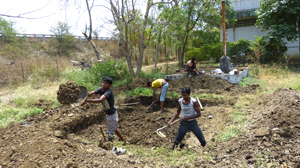
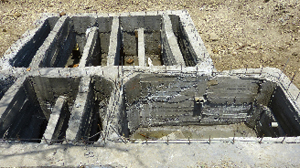
Excavation and construction showing the completed concrete containment tanks of the Sangam’s Phytorid beds
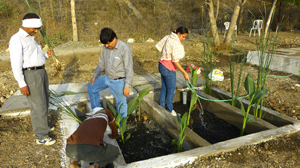
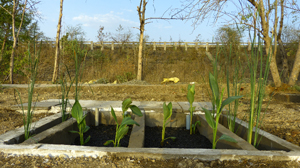
Filling and the planting of the wetland plants (Canna lilies and reeds) that provide the filtration of the waste water
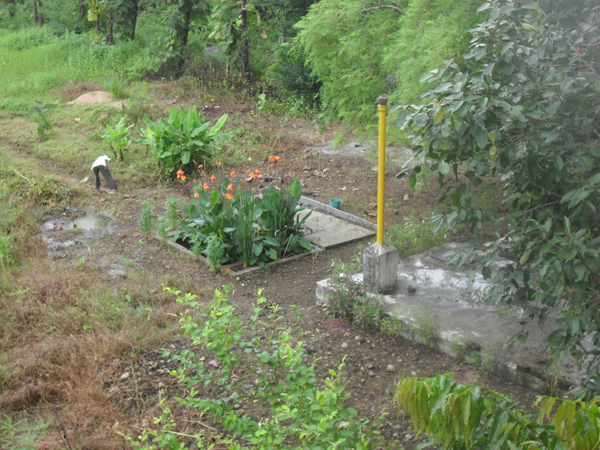
Completed Effluent Treatment unit after the filtration plants (bio-filters) have grown up and the surrounding area has been reinstated.
The main benefits of this system are that there is no requirement for electrical power. It has a low capital cost compared with standard sewage/effluent treatment systems and is simple to construct and replicate. It is low costs technology and low maintenance. Can be replicated and useful for villages and colonies and can also be extended to cover industrial wastewater treatment.